
Clearwater County Court Records After a Jail Arrest
After a person is arrested in Clearwater County and booked into the Clearwater County Jail, the public record can split into two tracks. The jail track is managed by the Clearwater County Sheriff's Office and shows current custody information. The court track begins when the Clearwater County Attorney reviews law-enforcement reports and files charges in Clearwater County District Court. The prosecutor's office is the chief prosecutor for crimes occurring in the county, including felony, gross misdemeanor, misdemeanor, and juvenile matters. The City of Bagley also contracts with that office for certain city criminal prosecutions.
The official jail roster can list initial booking charges or amended charge text, but those entries are not convictions and may not match the final court complaint. The county attorney page explains the difference in plain terms: charging requires probable cause to believe a specific defendant committed a specific crime on a specific date in the county, while conviction requires proof beyond a reasonable doubt. For custody and booking detail, use the Clearwater County jail inmate records page. For booking-photo questions, use the jail roster mugshots page. Court records after an arrest should be checked through the court and prosecutor channels below.
The Clearwater County District Court sits in the Clearwater County Courthouse at 213 Main Avenue #303, Bagley, MN 56621. The court is part of Minnesota's Ninth Judicial District and has original jurisdiction over criminal, traffic, civil, family, probate, and juvenile cases filed in the county. Court Administrator Carissa Scholz is listed on the court page, and public court contact numbers are 218-935-4020 and 833-202-3535. The district court page lists weekday hours of 8:00 a.m. to 4:30 p.m., plus free public surface-lot and on-street parking.
The Minnesota Judicial Branch page for Clearwater County District Court is the court's official contact and calendar source.
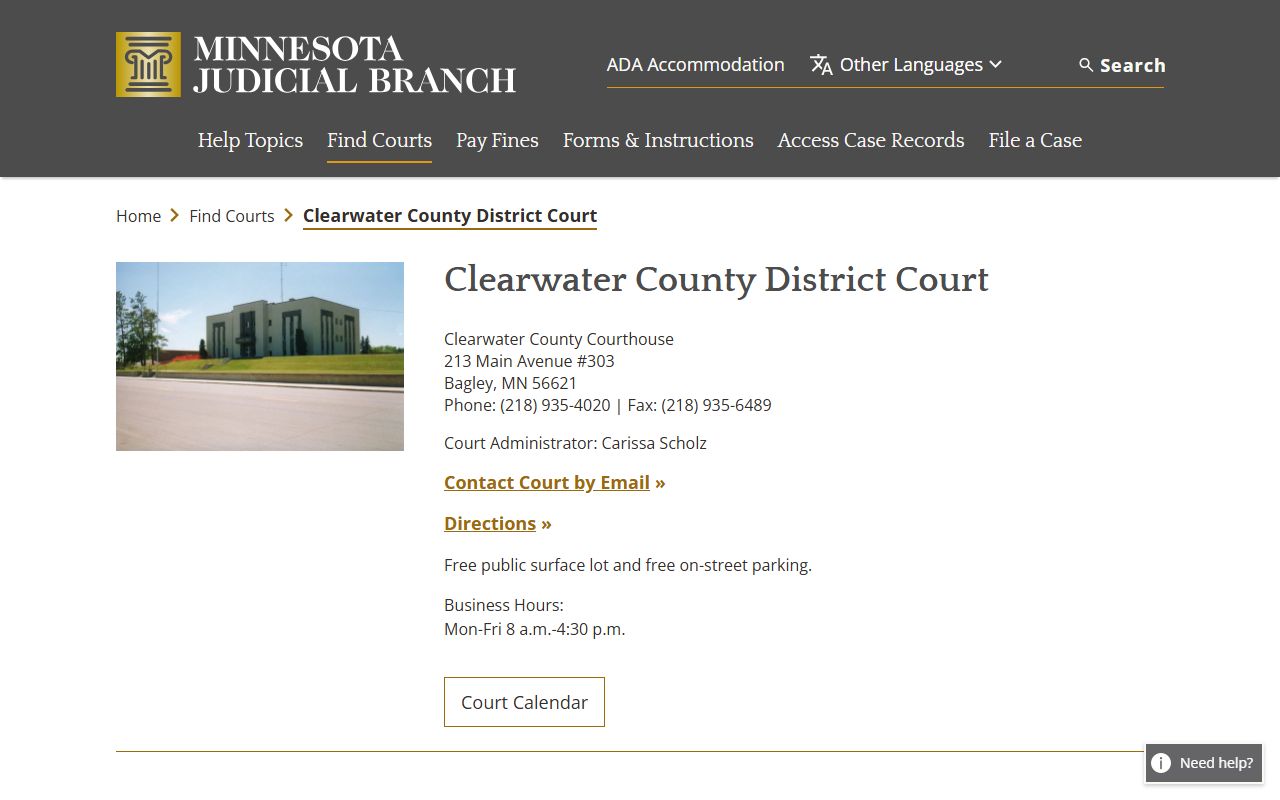
Use the court page for phone numbers, hours, parking notes, and calendar links before relying on older third-party courthouse directories.
How to Find Court Records After an Arrest
Minnesota Court Records Online, usually called MCRO, is the first remote search channel for many public Minnesota district court case records and documents. Search by defendant name or case number after a case is filed. A very recent arrest may not appear immediately, and some confidential, sealed, juvenile, or non-remote records will not be fully visible online. If the case cannot be found in MCRO, use the Clearwater County District Court office or courthouse public access terminals.
- Start with the Clearwater County inmate list for booking date, name spelling, and initial charge or hold language.
- Search MCRO by defendant name. If a case number is available from a calendar, warrant, notice, or court document, search by that number.
- Open the matching case and compare the filed charges against the jail roster charge text.
- Review each charge for level, statute, status, hearing history, and disposition when public.
- Check the weekly public court calendar for upcoming hearings such as first appearance, Rule 8 appearance, arraignment, omnibus hearing, pre-trial, sentencing, probation violation, review hearing, or contested revocation.
- For older files, locally stored paper records, or fuller electronic access, use courthouse terminal or counter access.
The Judicial Branch access page says courthouse public access terminals provide the most complete access to electronic district court case records. That matters in Clearwater County because a court record after a jail arrest may have public docket events online while some documents or older local records require courthouse access.
The Minnesota Judicial Branch Access Case Records page explains MCRO and courthouse terminal access.
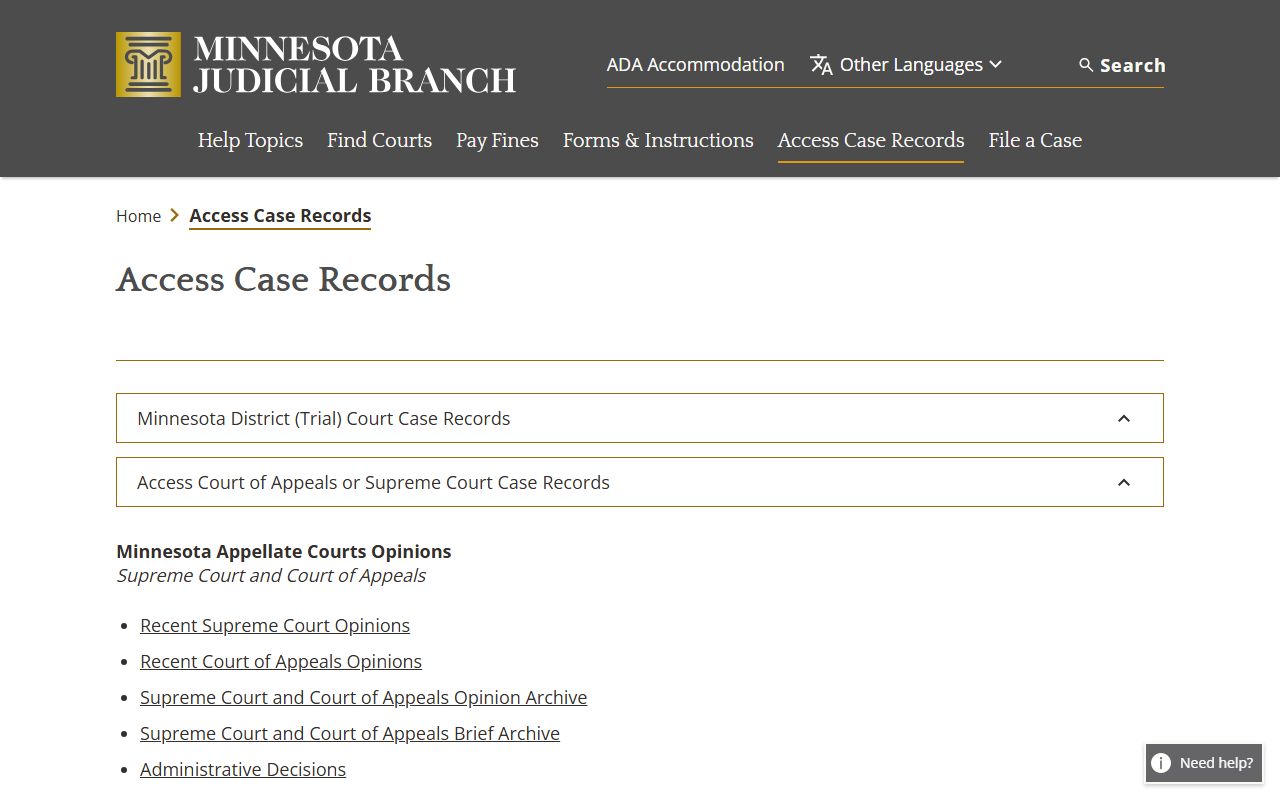
MCRO is a useful starting point, but the courthouse remains the fallback when remote access is incomplete or a newly filed case has not fully posted.
Charging Documents After an Arrest
The court record usually starts with a charging document rather than with the jail booking entry. In many Clearwater County criminal cases, that document is a complaint filed after the county attorney reviews reports from sheriff deputies, Bagley police, or another investigating agency. The complaint identifies the defendant, alleged offense, date, jurisdiction, and probable-cause basis for the charge. Other charging routes can exist, but the key practical point is that the filed document is the court source, while the roster is a custody source.
| Document or Source | Who Creates It | What It Tells You | Record Caution |
|---|---|---|---|
| Jail roster charge | Clearwater County Jail or booking system | Initial charge or hold reason tied to custody | County warns charges may be initial or amended and are not proof of guilt |
| Criminal complaint | Clearwater County Attorney | Filed court charges and probable-cause narrative when public | May differ from booking text after prosecutor review |
| Court calendar entry | Minnesota Judicial Branch | Hearing date, time, case number, hearing type, party, and judicial officer | Not a complete case file and not all matters are included |
| Disposition or sentence | District court | Final outcome such as conviction, dismissal, plea, sentence, or probation order | Must be read charge by charge because mixed outcomes are possible |
Charge Status in Clearwater County Court Records
Charges can change after arrest. A prosecutor may file fewer charges than the booking entry suggested, add a charge after reviewing evidence, amend the offense level, dismiss a count, or resolve one count by plea while another remains pending. Court records should be read by individual count, not just by the case headline. A single case can include a dismissed count, a conviction count, and a probation-violation issue at the same time.
| Status | Plain Meaning | What to Verify |
|---|---|---|
| Pending | The charge is filed and no final public disposition has been entered. | Next hearing, bond conditions, and whether the person is still in custody. |
| Amended | The prosecutor or court record changed the charge, count, level, or wording. | Original roster language against the filed court count and later amendments. |
| Dismissed | The court record shows the count was dropped or dismissed. | Whether other counts in the same case remain active or resulted in conviction. |
| Convicted | A guilty plea, verdict, or adjudicated outcome has been entered for that count. | Sentence, probation terms, jail credit, fine, and whether appeal or expungement issues exist. |
| Warrant or revocation issue | A missed hearing, probation matter, or other order may affect custody. | Active warrant status, bond, and any separate agency hold. |
Bond, Release, and Court Hearings After an Arrest
Clearwater County's jail page does not publish a complete bond-payment procedure, accepted payment types, or jail bond-window hours. The public roster also did not show bond fields during inspection. Bond and release should be verified directly with the jail or sheriff at 218-694-6226 or with Clearwater County District Court at 218-935-4020 or 833-202-3535. Release decisions are court-driven and can change at hearings.
| Bond or Release Type | How It Works | Clearwater County Checkpoint |
|---|---|---|
| Cash bail or bond | The required amount is paid through the proper court or jail process. | Confirm payment location, timing, and refund rules before sending money. |
| Surety bond | A bonding company posts security where allowed. | Official sources did not list approved companies or fees. |
| Conditional release or own recognizance | The court allows release based on conditions rather than full cash payment. | Read the court order and hearing minutes for conditions. |
| No-bond hold | Posting money will not release the person because another order or hold controls custody. | Ask whether a warrant, probation hold, DOC hold, federal hold, ICE matter, or another county is involved. |
| Warrant bond | The active warrant list may show a bond amount. | The sheriff says warrants are verified before arrest, so verify the amount before acting. |
Warrants, Arrest Records, and Court Calendar Clues
Clearwater County publishes an official active warrant list with fields for warrant number, first, middle, and last name, date issued, bond, and charges. The sheriff's office directs people with information about listed individuals to call 218-694-6226 and states that all warrants will be verified before an arrest is made. Treat the list as a lead, not as the final authority. Warrant status can change, and a listed bond may not resolve another hold.
The weekly public court calendar is another useful court-record channel after an arrest. Calendar entries can show the party name, hearing location, date and time, judicial officer, hearing type, connection type, and case number. The research sample included criminal case numbers in the 15-CR format for Clearwater County. The calendar is posted at 7:00 a.m. each business day and updated hourly, but it is not a full case file and excludes confidential or non-remote matters.
Charges vs. Convictions in Court Records After Arrest
An arrest and a charge do not mean the person was convicted. Clearwater County's inmate list itself warns that listed charges are not admissions of guilt and do not guarantee conviction. The prosecutor must first decide whether probable cause supports charges. Later, conviction requires proof beyond a reasonable doubt, normally through a plea or verdict. That difference is central when reading court records after a jail arrest.
| Charge | Conviction | |
|---|---|---|
| Stage | An accusation or filed count after arrest and review. | A final adjudicated outcome by plea, verdict, or court finding. |
| Proof standard | Probable cause is enough to file or support the charge. | Proof beyond a reasonable doubt is required for conviction. |
| Where it appears | Jail roster, complaint, MCRO docket, warrant list, or calendar. | Disposition, sentencing entry, judgment, or probation order. |
| Public meaning | Not proof of guilt and may be amended or dismissed. | Can carry sentence, supervision, fines, and collateral consequences. |
Sealed vs. Expunged Court Records After an Arrest
Minnesota record access is shaped by public-record laws, court rules, and expungement statutes. Minnesota Statutes section 609A.02 sets expungement eligibility grounds and limits. Minnesota Statutes section 609A.03 describes the petition procedure, including filing-fee and fee-waiver references. Expungement does not mean every public mention disappears automatically on the same day, and it does not turn an arrest into a conviction. It is a court process that can limit public access to eligible records.
| Sealed | Expunged | |
|---|---|---|
| Visibility | Restricted from ordinary public access by court order or rule. | Sealed under Minnesota expungement authority for eligible records. |
| Access limits | Some agencies or courts may retain limited access depending on the order and law. | Access depends on the statute, order, agency, and type of record. |
| Common trigger | Confidential case type, juvenile matter, protected data, or court restriction. | Eligible dismissal, acquittal, diversion, stay, or conviction category under chapter 609A. |
| Practical step | Ask the district court what access is allowed. | Review sections 609A.02 and 609A.03 or consult counsel before filing. |
Background Check Considerations
Casual public lookup is not the same as a lawful employment, tenant, credit, insurance, or licensing background check. Court records can be incomplete remotely, roster charges can be preliminary, and sealed or expunged records require careful handling. Anyone making an FCRA-regulated decision must use lawful channels and follow the required notice, consent, dispute, and adverse-action rules.
Important: This private resource is not a consumer reporting agency and cannot be used for FCRA-regulated decisions.
Restricted Court Records After an Arrest in Clearwater County
Minnesota law makes many arrest, charge, court calendar, and booking records public, but public access has limits. Minnesota Statutes section 13.82 covers law-enforcement data, including arrest data and adult booking photographs, with temporary withholding allowed when release would harm an active investigation. Section 13.85 covers corrections and detention data. Section 641.05 requires the sheriff to maintain a permanent jail record for people committed to jail, but that does not make every internal detail public.
Expect limits for juvenile records, medical and mental-health information, victim data, security information, active investigative material, confidential filings, sealed cases, and some non-remote court documents. When online records are missing or unclear, use the official county public information request form source, the sheriff's office, or the district court counter instead of guessing from a roster entry.